We work directly with your operation, not around it.
We engage with the conditions that create exposure, not just the documentation that describes them.
Where Engagements Begin
Most engagements begin with a specific condition that creates uncertainty, pressure, or loss of control within operations. These are not abstract concerns—they are situations where exposure to serious outcomes is either known or suspected, and where existing safety efforts may not fully reflect operational reality.
We engage when organizations need a clear understanding of what is actually happening within their operations, how exposure is developing, and what must be addressed to stabilize conditions and maintain control.
Common Starting conditions
-
An event has occurred, or nearly occurred, that indicates the presence of uncontrolled exposure. The priority is stabilizing operations, understanding conditions without hindsight bias, and establishing a clear path forward.
-
An organization is under review following an incident or identified concern. The need is to establish a defensible position, manage engagement with regulators, and ensure that responses reflect actual operational conditions—not assumptions.
-
Leadership or operational teams recognize that current safety programs, metrics, or reporting do not fully explain the level of risk within the operation. The objective is to identify where exposure exists and how it is being managed in practice.
-
An acquisition is being considered or has recently occurred. The focus is on understanding exposure within the target operation and aligning systems, expectations, and governance structures during integration.
-
Written procedures, policies, or safety expectations do not match how work is actually performed in the field. This gap creates unmanaged exposure that is often invisible until an event occurs.
-
Rapid growth, new contracts, or expanded scope introduce conditions where existing systems may not scale effectively. The need is to maintain control as operational complexity increases.
During the work
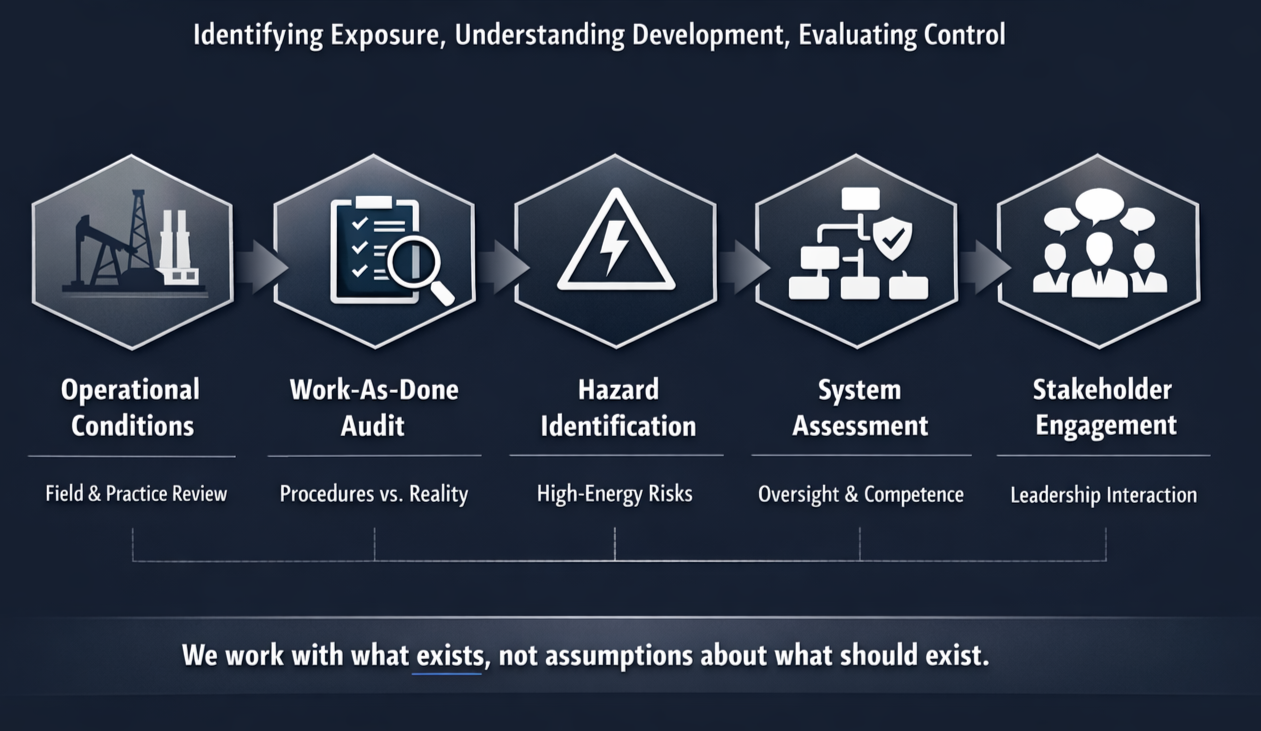
The focus is on identifying exposure, understanding how it develops, and evaluating how it is controlled.
This typically includes:
Review of operational conditions and field practices
Evaluation of work-as-done versus written procedures
Identification of high-energy hazard exposure
Assessment of supervision, qualification, and system structure
Direct interaction with leadership, field personnel, and stakeholders
What You Get
Clear, structured outputs tailored to your operational conditions—defining exposure, supporting decisions, and guiding control.
Outputs are provided in formats appropriate to the engagement, including structured reports, visual models, executive briefings, and working sessions with leadership.These outputs are not static deliverables. They are used to clarify what is happening within your operation, support defensible decisions, and establish control where it is currently uncertain.
Exposure Clarity
A defined understanding of where exposure to serious outcomes exists and how it develops within operations.
Governance Structure
Defined systems for oversight, qualification, and accountability aligned with operational reality.
Defensible position
A defined understanding of where exposure to serious outcomes exists and how it develops within operations.
Stabilization Path
A structured path forward following serious incidents or disruption, focused on restoring control and continuity.
Operational Alignment
Visibility into how work is actually performed, including gaps between written procedures and field conditions.
Integration Clarity
Understanding of exposure and system alignment during pre- and post-acquisition transitions.

The backbone of our work is deep, applied experience across high-risk operations, serious incidents, and the systems that govern them.
Our team includes professionals with advanced academic training and industry-recognized credentials, including PhDs, CSP, CUSP, and advanced OSHA certifications. This experience is not theoretical—it has been developed through direct involvement in incident response, regulatory engagement, and operational evaluation.
We contribute to industry standards, regulatory dialogue, and the evolution of how exposure is understood and managed in complex environments.
That experience is applied to your operation in a practical way—clarifying conditions, supporting decisions, and guiding implementation.
We do not stop at assessment.
We support the development of leadership capability, system alignment, and structured roadmaps required to implement change and maintain control over time.